Blog Post #8 – Open Education Theories

What is Open Education?
Open education is a method of education that focuses on making education more accessible to people. This is usually done through online education, utilizing Open Educational Resources (OERs) such as textbooks, videos, articles, personal learning networks, educational platforms and online courses (BC Campus, 2020). I came across three learning theories that are learner-centered: behaviorism, cognitivism, and constructivism. The below diagram describes the three aforementioned education theories.
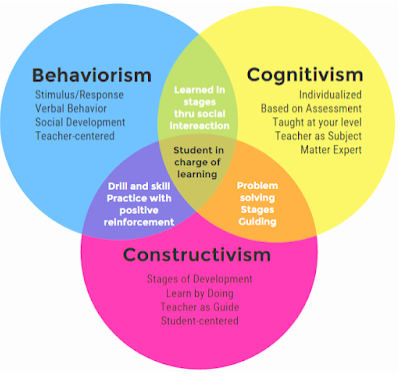
Some Learning Theories
Behaviorism
Behaviorism follows the idea that “practice makes perfect.” Effectively, it is when learners do or experience something, then learn from that experience. The learning is “shaped by environmental stimuli, both positive and negative” (Lee T., 2016). Learners can learn from completing assignments and repeating tasks and interactions, as well as abstain from bad practices after negative reinforcement.
Cognitivism
Unlike behaviorism, cognitivism focuses on the way the mind processes information. Instead of learning from actions and behavior, cognitivism suggests that knowledge and experience can help learners understand a concept more comprehensively. One method that is suggested by Trevor Lee (2016) is to start the discussion with a hook to create interest, then using a plethora of multimedia tools such as quizzes and visual information that puts learners in an active learning role (as opposed to a passive learning role).
Constructivism
Relative to behaviorism, constructivism is more learner-centered, as learners are given the opportunity to learn new ideas and concepts by discovering them in their own way. Similarly to cognitivism, constructivism focuses on internal processing of information rather than the repetition of actions. The “self-directed” nature of constructivism allows educators to take a step back and let learners have more control over their learning (Lee T., 2016). This occurs because learners can actively learn, explore and reflect on concepts on their own.
References
Ahmad, A. (2020). 3 Major Learning Theories: Behaviorism, Cognitivism And Constructivism. Someone’s White Star. https://hamizahmohdisa.blogspot.com/2019/10/3-major-learning-theories-behaviorism.html?m=0
BC Campus. (n.d.). What is Open Education? https://open.bccampus.ca/what-is-open-education/
Lee T. (2016). Learning Theories: Behaviorism, Cognitivism, Constructivism, and Connectivism. https://traviselearning.net/blog/2016/2/25/learning-theories-behaviorism-cognitivism-constructivism-and-connectivism